
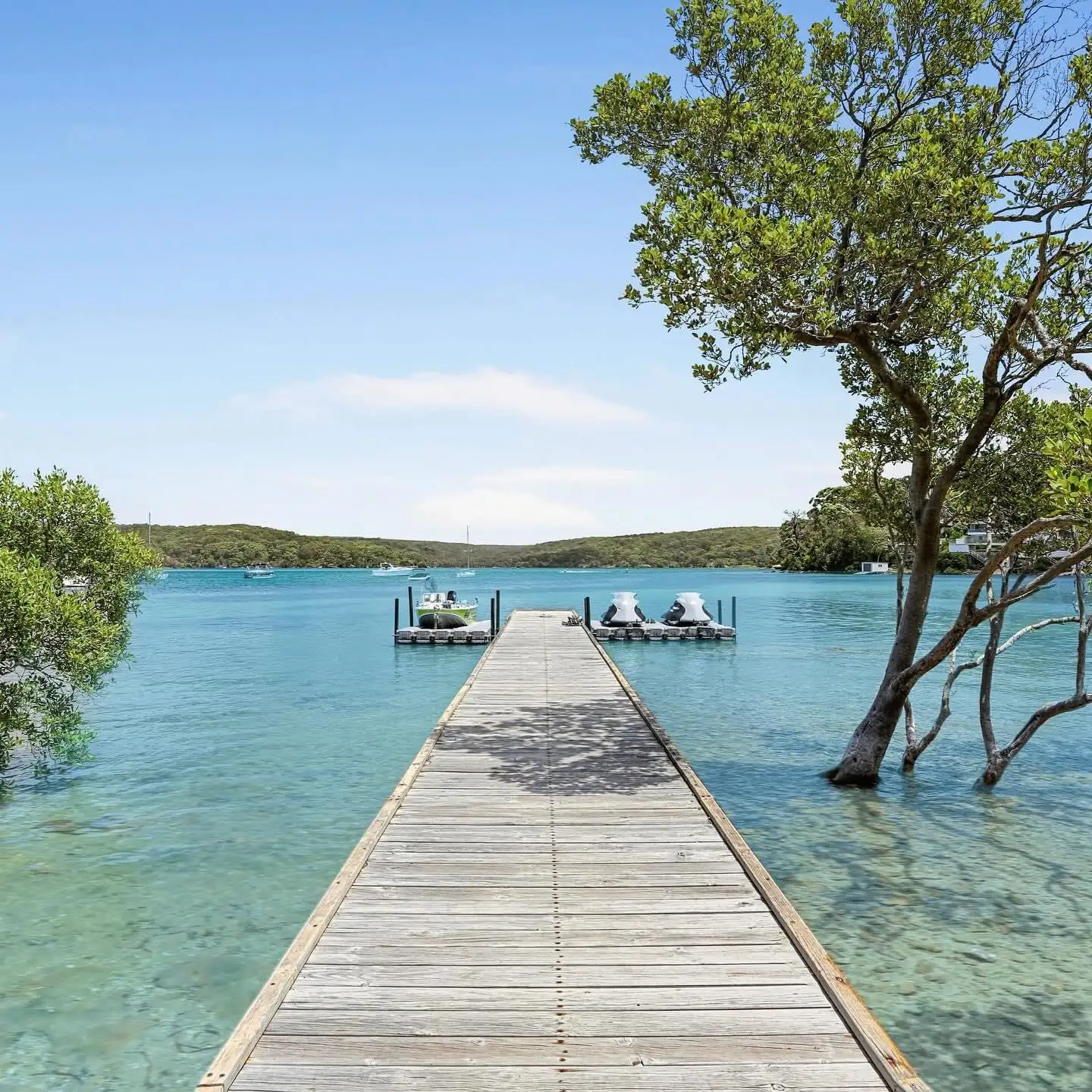
In one line: a boat jetty is a fixed walkway on piles running from the shore over the water; a pontoon is a floating platform the boat ties up alongside; a floating dock is a modular float the boat drives up onto, so the hull sits clear of the water.
Most people who want a new boat jetty on the Port Hacking already have a picture in mind: a pontoon like the neighbour’s, or a dock the jet ski drives straight onto. Then someone measures the water at the bottom of a spring low, and the picture changes. Which of the three you can build comes down to that depth and the boat you own, and getting a new structure approved takes far longer than building it. Below is how each option works, the mistakes that cost owners money, and how to check your own frontage first.
Fixed timber, floating dock or pontoon: what decides it
Two questions sort every frontage. How much water is there at zero tide (the lowest predicted tide, close to the bottom of a spring low)? And does your boat need to come out of the water, or just sit level beside you?
The depth that matters is 600 mm. On Sydney waterways, that’s the least water a pontoon generally needs at zero tide before it will be approved. Any shallower and it sits on the seabed at low water and damages it, so it gets knocked back.
Fixed timber jetty: works at any depth
A fixed jetty is a deck on piles at a set height. It doesn’t move, so your boarding step changes with the tide: at the bottom of a spring low you can be stepping a long way down into the boat.
It’s the right boat jetty for shallow frontages, for heavier boats berthing against a wharf, and for a jetty used mostly for fishing and swimming. It’s also the walkway that carries you out to a pontoon or dock in deeper water. Built properly, it lasts 30 to 50 years with the decking and fittings refreshed along the way.
The piles decide that lifespan. Kingtide builds on HDPE piles with a concrete core and galvanised reinforcement (the most common residential choice, because it’s the most cost-effective and lasts longest) or turpentine piles, whose natural silica resists marine borers better than almost any other timber. Decking is spotted gum, with ironbark for bearers and joists, all fixed with marine-grade stainless steel.
Floating dock: lifts the boat out of the water
A floating dock is a set of buoyant modules with a section shaped for the hull. You drive on, and a small hand winch at the front pulls the boat the last bit and locks it off. No electrics and no motor, which is why it holds up in salt water.
The point is getting the hull out. A boat that sits in the water year round grows barnacles, weed and oysters, the antifoul works overtime, and every trip starts with a scrub. On a dock the hull stays clean and a launch takes five minutes, so the boat actually gets used.
Unlike a pontoon, a floating jet ski dock needs very little water. It can even sit on the seabed at low tide, so it works on frontages too shallow for a pontoon. Docks suit jet skis, tenders and small runabouts: think of an average trailer boat as the upper limit. Most residential docks arrive one to three weeks after approval and go in over one or two days, usually alongside an existing jetty or pontoon.
Pontoon: keeps the boat level beside you at every tide
A pontoon is a floating platform you tie the boat alongside, so the boat stays in the water. It rides up and down guide piles on rollers, so stepping aboard feels the same at 6 am low water as at the afternoon high. Where piles won’t suit, it hangs off hinge brackets at the end of the ramp.
It’s built either as fibreglass over a timber subframe (the traditional, good-value option) or as a fully moulded fibreglass shell, which costs more upfront but has no timber inside to rot. About 85% of the pontoons Kingtide installs are 3.6 × 2.4 m, which takes a family boat with room to walk around it.
Most frontages combine two of them
On most Sydney frontages the 600 mm sits some distance out, so the usual setup is a fixed jetty over the shallows, a hinged gangway down to a pontoon in deep water, and the boat berthed there. A floating dock for the jet skis often goes alongside the jetty or pontoon. If your site has the depth, that combination is what we’d build.
FRP mesh replaces timber decking over seagrass
FRP (fibre reinforced polymer) grating lets light through to the seabed. That matters over seagrass: the Port Hacking’s Posidonia australis meadows arelisted as an endangered populationunder the NSW Fisheries Management Act, and a light-penetrating deck is often a condition of approval. It also needs no oiling and grips when wet.
| Fixed timber jetty | Floating dock | Pontoon | |
|---|---|---|---|
| Water at zero tide | Any depth | Very little; can sit on the seabed at low tide | 600 mm or more where it floats |
| Where the boat sits | In the water, tied to the jetty | Out of the water, on the dock | In the water, alongside |
| Boarding at low tide | A long step down | Level | Level |
| Best for | Shallow frontages, fishing, heavier boats on a wharf | Jet skis, tenders and small runabouts | Family boats you use often |
| Yearly upkeep | Oil deck, check fixings | Check brackets and winch | Grease rollers, check floats |
| Typical cost, Sydney (AUD) | $2,800–$6,500 per metre | $3,000–$8,000 for one jet ski; $8,000–$16,000 for two | $48,000–$78,000 for 6 × 4 m with gangway, before approvals |
What each boat jetty costs in Sydney
It’s hard to put one price on a jetty because the variables swing too far: how far out the 600 mm sits, how many piles, HDPE or steel, the timber species, and whether everything comes in by barge. These ranges give a starting point.
- Fixed timber jetty: anywhere from $2,800 to $6,500 per metre in Sydney, depending mostly on piling, barge access, timber species and size.
- Pontoon: $48,000 to $78,000 supplied and installed for a 6 × 4 m pontoon with two piles and a 6 m aluminium gangway, before approvals, or $56,000 to $92,000 all-in with a straightforward licence and council consent (Going Rate, November 2026).
- Gangway on its own: $8,000 to $12,000 up to 6 m, and $14,000 to $22,000 for 6 to 10 m (Going Rate).
- Floating jet ski dock: about $3,000 to $8,000 installed for one ski, and $8,000 to $16,000 for two. The final price depends on the dock system, how it’s anchored or fixed to the pontoon, access, and whether approval is needed.
Approvals sit on top. Going Rate puts a straightforward NSW application at $4,500 to $9,000 including drawings and lodgement fees, rising to $18,000 to $35,000 in consultant reports on complex sites such as those with seagrass. Treat all of these as a guide: the depth, the piles and how the site is reached decide your quote.
Where boat jetty projects go wrong
Most failed jetty projects we’re called to look at trace back to a decision made before anyone picked up a tool. Five come up again and again.
Booking the build before the approval is through
A new jetty sits over Crown land, so it needs council consent and aCrown Lands domestic waterfront licence. Where seagrass or fish habitat is involved, NSW Fisheries has a say too. Together that takes about 18 months on a new structure, and Crown Lands itself warns that processing can be lengthy.
Owners who order a pontoon or promise the family a summer on the water before consent lands end up waiting with a deposit paid. Start the approvals first, with a planner who does marine applications rather than general residential work, and plan the build date from the consent.
Adding the pontoon later
If your frontage has the depth, put the jetty, gangway and pontoon in one application. A pontoon added a few years on almost always needs its own approval, because it’s treated as an alteration or addition to the existing structure, often with Crown Lands owner’s consent and Fisheries input as well. Sydney councils see these regularly: a recent Northern Beaches DAcovered a new ramp, pontoon and berthing area added to an existing jetty. The jetty may also need rework to take the gangway hinge. We’d only build the jetty alone if the budget genuinely isn’t there yet, and even then we’d design the end for a future gangway.
Putting too much boat on a floating dock
Floating docks are brilliant for jet skis, tenders and small runabouts. Owners get into trouble when they size one for a heavier boat because it looked easy at the boat show. Once a boat gets past about 6 to 7 m or 2 to 3 tonnes, or the site is exposed to wash and swell, a slipway, cradle or boat lift does the job better. A good rule of thumb: keep it around the size of an average trailer boat.
Saving money on piles and fixings
When a jetty fails early, it’s almost always one of two things: piles that weren’t driven to an engineered depth, or the wrong materials, such as untreated timber that marine borers chew through or fixings that corrode in salt water. Both sit below the deck where you can’t see them.
Our position: if the budget’s tight, spend it on the piles and stainless fixings and save on the decking, which you can upgrade later. A cheaper pile can’t be swapped without pulling the jetty apart.
Skipping the yearly once-over
Rollers, float fixings and gangway hinge brackets wear quietly, then go all at once, usually in an east coast low on a king tide. A failed pontoon on the seabed is a salvage job and costs several times what the repair would have.
An hour or two a year fixes it: grease the rollers, check the floats and freeboard, tighten deck fixings and look over the hinges. Do it again after any major storm.
Five things to check before you call a builder
You can answer most of the big questions about your boat jetty from your own backyard in a weekend. Bring these to the first site visit and the conversation skips straight to what’s possible.
- Your depth at zero tide. Check the Bureau of Meteorology tide predictions for the lowest low of the month. At that time, measure the water with a marked pole where the boat would sit, not at the end of the old jetty. Under 600 mm, plan on a fixed jetty or reaching further out.
- Whether there’s seagrass. On a calm, sunny low tide, look from a kayak or snorkel the line of the jetty and take photos. Seagrass doesn’t rule a jetty out, but it shapes the route and the decking.
- Your boat’s numbers. Length, beam, draft and weight, plus any jet skis. They set the pontoon size and how deep the water has to be.
- Your existing paperwork. Find the current Crown Lands licence and any old council approval for the structure that’s there. Replacing a licensed jetty is a different conversation from building new.
- What you want from it. A boat you use every weekend points to a pontoon. Jet skis you want kept clean point to a floating dock. Fishing off the end and a swim in summer may only need a fixed jetty, which is simpler to approve and maintain.
With those five answers, a builder can tell you at the first inspection which of the three setups your frontage allows, and roughly how long the approval will take.
No depth and only a tinnie? A skid ramp might be enough
If your water is shallow and the boat is a tinnie, a kayak or paddleboards, a jetty may be more structure than you need. A skid ramp is a fixed sloping deck running from your land into the water, and you slide the hull up and down it. It costs a fraction of a jetty, ramp and pontoon. Built in high-grade turpentine, it lasts ten to twenty years. It still sits on Crown land, so it needs approval like any other waterfront structure.
Boat jetty FAQs
Does my home insurance cover my jetty or pontoon?
Often it doesn’t any more. A number of insurers have pulled back from waterfront structures, so a policy that covers your house may exclude the jetty, pontoon and seawall. Check the product disclosure statement for marine structures and storm cover before you build, not after the first east coast low.
Can I replace my old jetty without a new approval?
It depends on how much you’re replacing. Minor alterations, repairs and maintenance to an existing jetty or pontoon can be done as exempt development, with no approval needed. Bigger works such as replacing piles and decking can go through the faster complying development path. A full demolish-and-rebuild usually needs a DA, even when it’s like-for-like, so ask a marine planner early which path applies.
Can I add a pontoon to the jetty I already have?
Yes, if there’s at least 600 mm at zero tide where the pontoon would float and the jetty end can carry a gangway hinge. It almost always needs approval, because it’s treated as an alteration or addition to the existing structure. Crown Lands owner’s consent and Fisheries input may be needed too.
Next steps
- Ready to build: book a free site inspection with Kingtide Marine. They’ll measure your depth at zero tide and tell you which boat jetty your frontage can take.
- Comparing options: see how a jetty, ramp and pontoon goes together, with photos of finished builds on the Port Hacking and Georges River.
- Still researching: read how waterfront DA approvals work for the full council and Crown Lands process.
Measure your water at zero tide before you fall for a pontoon. That one number tells you which boat jetty you can build.